Summary
Inferred Mind is an AI tool built for political campaigns, helping copywriters and campaign leads react fast, write authentic messages, and keep pace with the shifting political moment. I worked on turning raw media insights into actionable tools, creating features that gave campaign teams a clearer starting point and reduced the friction of generating content under pressure.
One of the first areas I worked with was the Research Hub. This was the foundation: a place where campaign teams could see what had happened in the media landscape—news headlines, trending TikToks, Instagram posts, tweets, and opinions from the voices they had chosen to track.
It wasn’t my design from scratch, but I collaborated on iterations until the Research Hub became the “control center” of the platform. It gave structure and direction, but it also exposed a bigger challenge: having all this data didn’t mean users knew how to act on it.
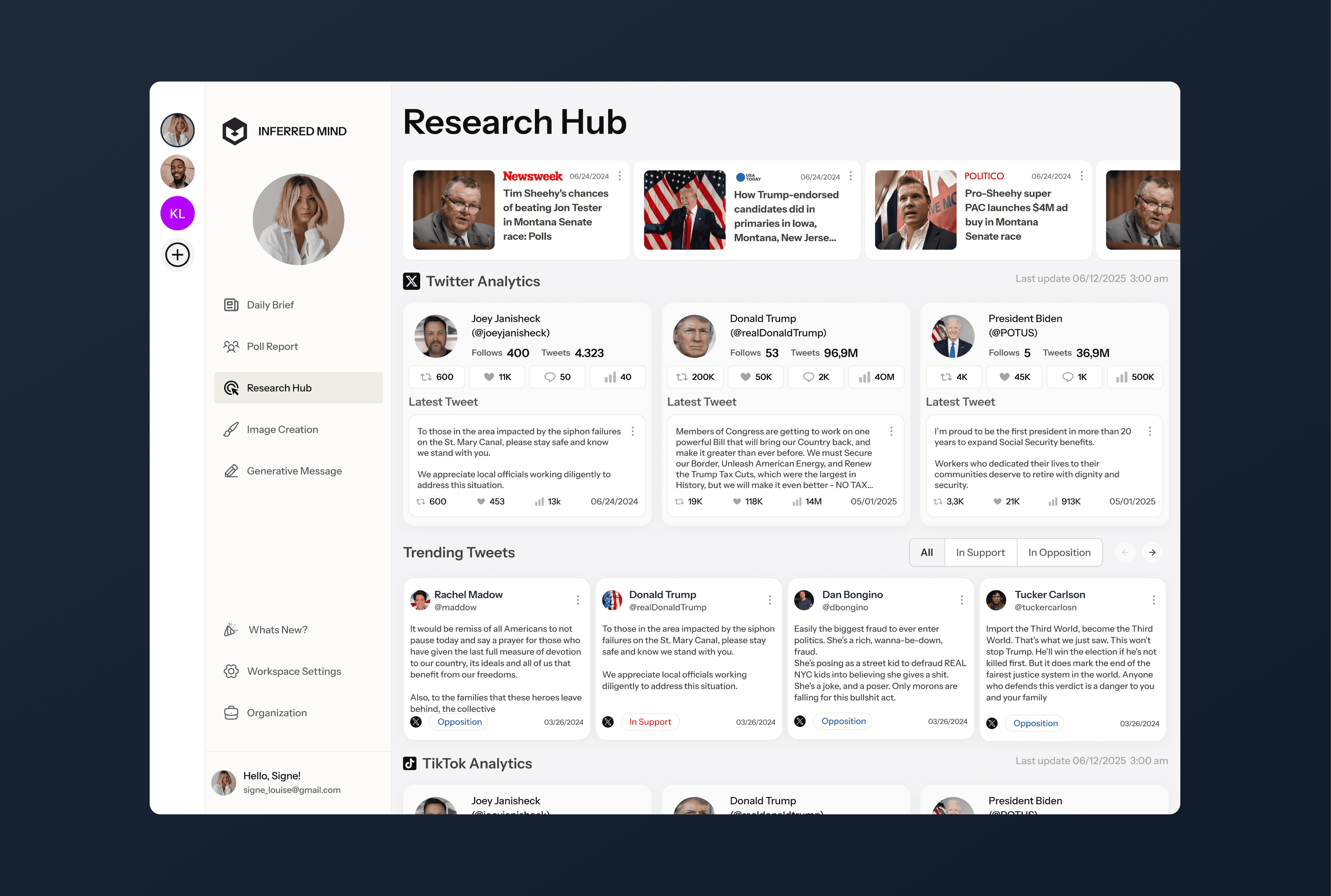
The Research Hub provided a foundation, giving teams a view of political headlines, trending stories, and conversations across media. But raw visibility was just the beginning of the real challenge was figuring out how to make that information actionable.
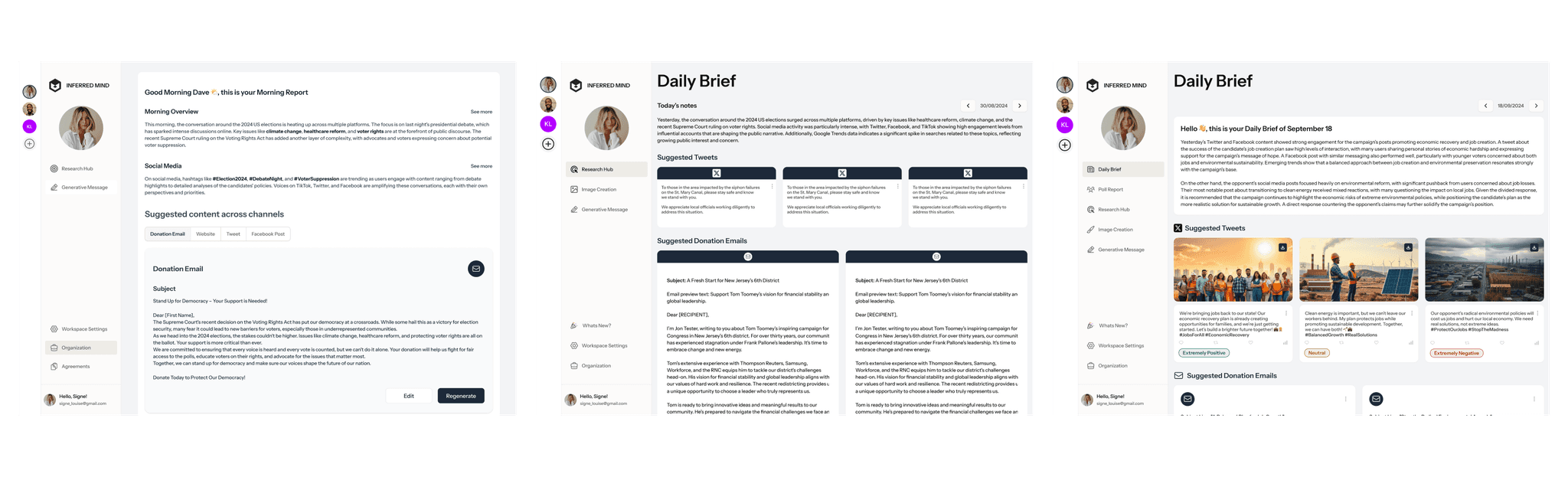
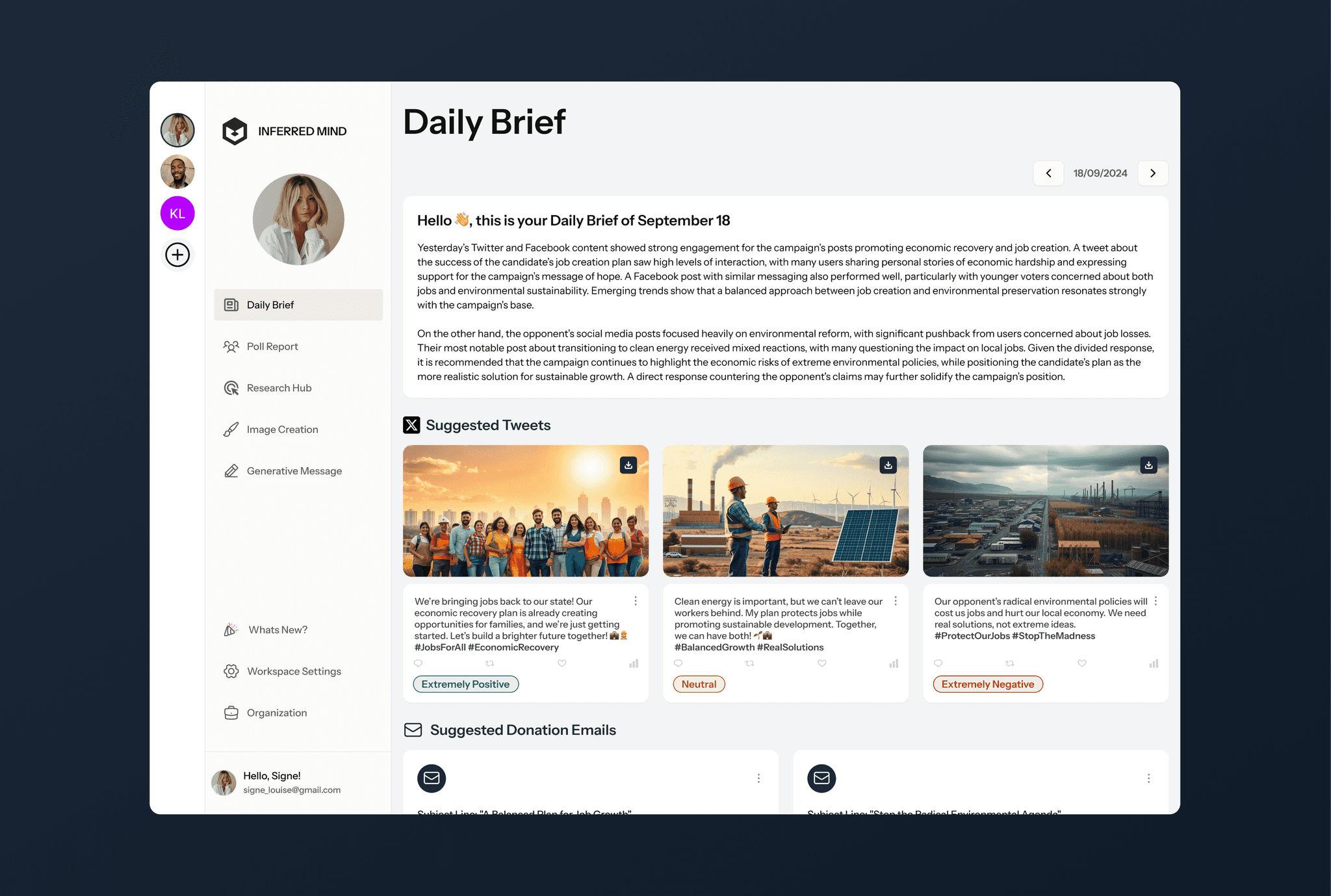
Every decision I made in shaping the next layer was grounded in a few core principles: to reduce friction, to provide context that could be immediately acted upon, and to guide users toward content that felt authentic to their candidate’s voice. One of the biggest challenges and ultimately, one of the most rewarding parts was creating a solution that condensed a day’s worth of political events into a format users could scan and use instantly.
The result was a concise, digestible briefing highlighting key topics, sentiment trends, and opportunities for reaction. Rather than starting from scratch, campaign teams could now see what mattered most and act immediately. By focusing on clarity, relevance, and speed, this Daily Brief transformed raw insights into a practical, actionable starting point, laying the groundwork for further tools that enabled fast, confident content creation.
Campaign teams don’t struggle with ideas. They struggle with getting started.
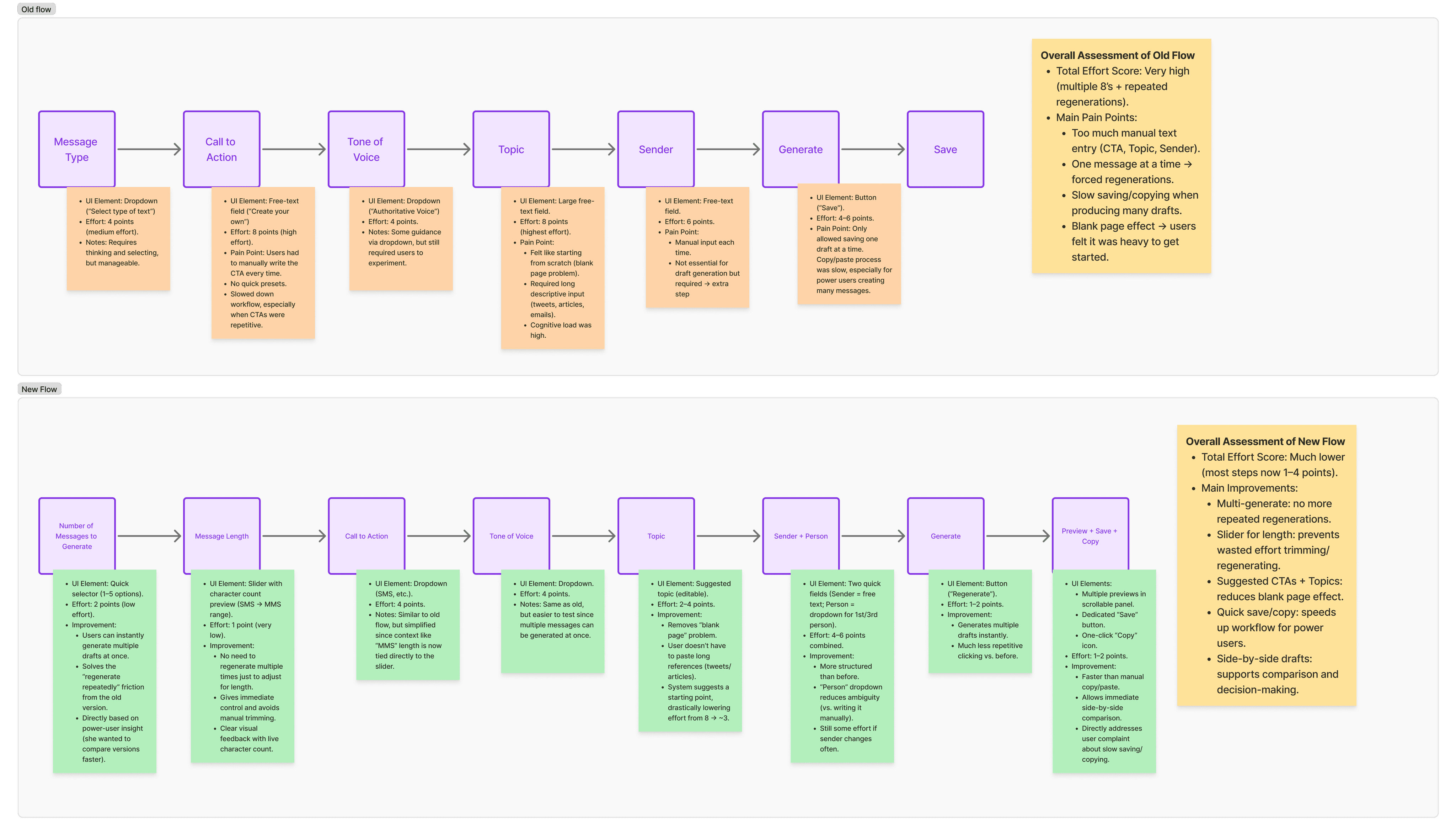
The original generator was meant to help turn insights into text messages, tweets, or emails. But instead of speed, it introduced friction:
Long free-text fields asking users to “just write something.”
Manual input for topics, tone, and calls to action.
Only one draft at a time, forcing constant regeneration.
It felt more like filling out paperwork than sparking creativity. Users told us directly:
“It just feels heavy to get started.”
We mapped the flow and scored effort. Writing long fields topped the scale (8 points of effort), while clicks and toggles scored lowest (1 point). Unsurprisingly, the original design leaned almost entirely on the highest-effort interactions.
Redesigning for Momentum
The redesign flipped that balance:
Message length slider with live character count → tweak without rewriting.
Generate 1–5 drafts at once → explore options in seconds, not minutes.
Suggested topics and CTAs → remove the blank-page paralysis, while still editable.
Quick selectors for tone, sender, and perspective → fast decisions, not free-text burden.
Instant save and copy → one click, no clipboard gymnastics.
In short: we replaced high-effort inputs with low-effort controls that still allow precision.
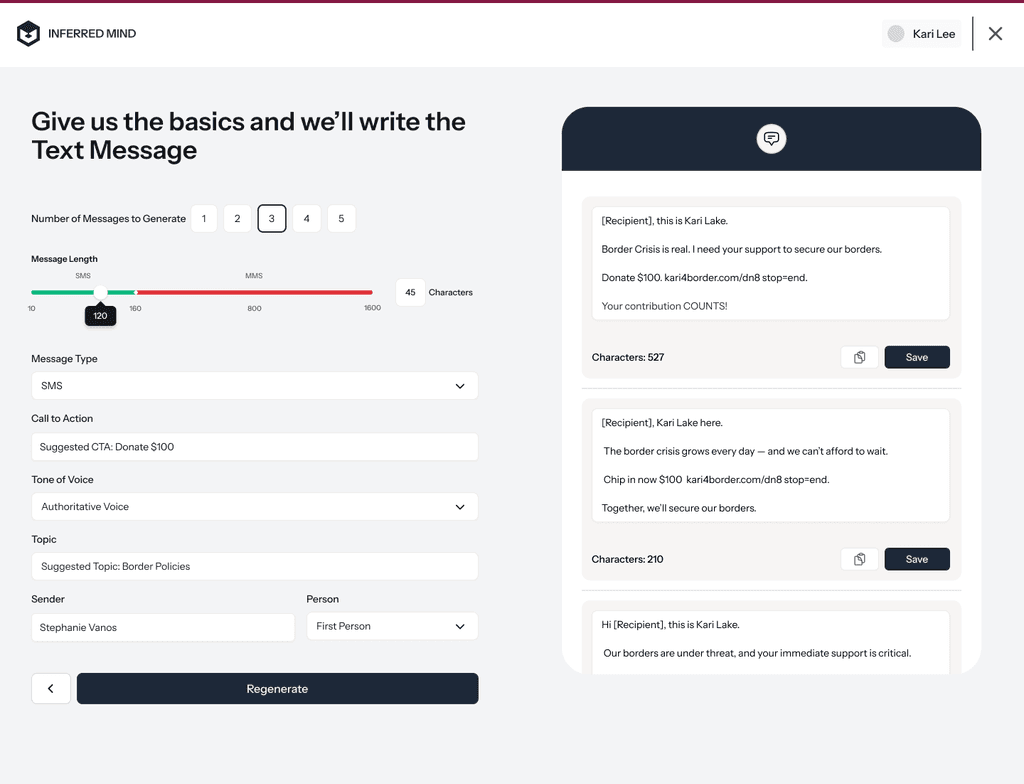
Instead of feeling like “work,” the generator became a creative kickstarter. In guided usability sessions with campaign teams:
Users reported lower friction and faster draft creation.
Several said the output was good enough to publish without edits.
The workflow shifted from “Ugh, I have to write this” → “Let’s see what I can spin up.”
This project wasn’t just about designing sleek interfaces, it was about making political data and content generation usable in the heat of fast-moving campaigns. From research insights to pre-generated media from the daily brief to a streamlined media generator, I wanted to show how design can turn complexity into clarity, giving teams tools that actually match the urgency of their work.
Collaboration was everything. Working closely with developers and campaign experts gave me a deeper understanding of both the technical core and the human side of the problem. It taught me that the best solutions happen when design thinking meets real-world constraints ,and when every iteration is guided by feedback, not assumptions.